
From a hilltop, we spotted it. A brown mass of fur and some white, sun bleached bones scattered about the tundra. Our camping trip in June to the Alaska Range held many adventures, and we were about to have another one- investigating the remains of a large dead animal.
Maybe odd to some, but thrilling to biologists, discovering a kill site holds an abundance of stories whose threads lead to questions answered. What type of animal is it? Did another animal kill it? Did it die from a hunter? How long has it been dead? Have other animals eaten off of it? These are some of the thoughts that rolled through my mind as we hiked our way out to the carcass that lay so quietly upon the tundra.
As we strolled up to the scene, we immediately spotted the skull along with lots of fluffy, coffee colored hair, rib bones, back bone, shoulder blades, pelvis and four lower legs complete with hooves attached. When we located the bleached white skull with telltale black, shiny horns attached, we knew we’d come upon the carcass of a bison. Not only was it a bison, but an adult female, based on the shape and size of the horns. Check out the detailed information on telling the difference between male and female bison on the Alaska Department of Fish and Game’s bison web page.
Then…..we struck gold! Benjamin pronounced, “Look, there’s a radio collar!” Near the skull and laying partly submerged in the earth and hide was a brown, three inch wide, radio telemetry tracking animal collar. Wildlife biologist’s use these collars to help locate animals which gives them valuable insight into herd population size, habitat utilization, seasonal movements, and predation rates, among other data. Josh grappled with the collar, tugging and pulling to get it free from the leathered hide, then began reading the faded out writing on the inside. It said, “Tagged in (the year) 201?”, but the last digit was faded completely out! We’d need to wait until we got back to McGrath to do some research with the fish and game department to see what year she was tagged.

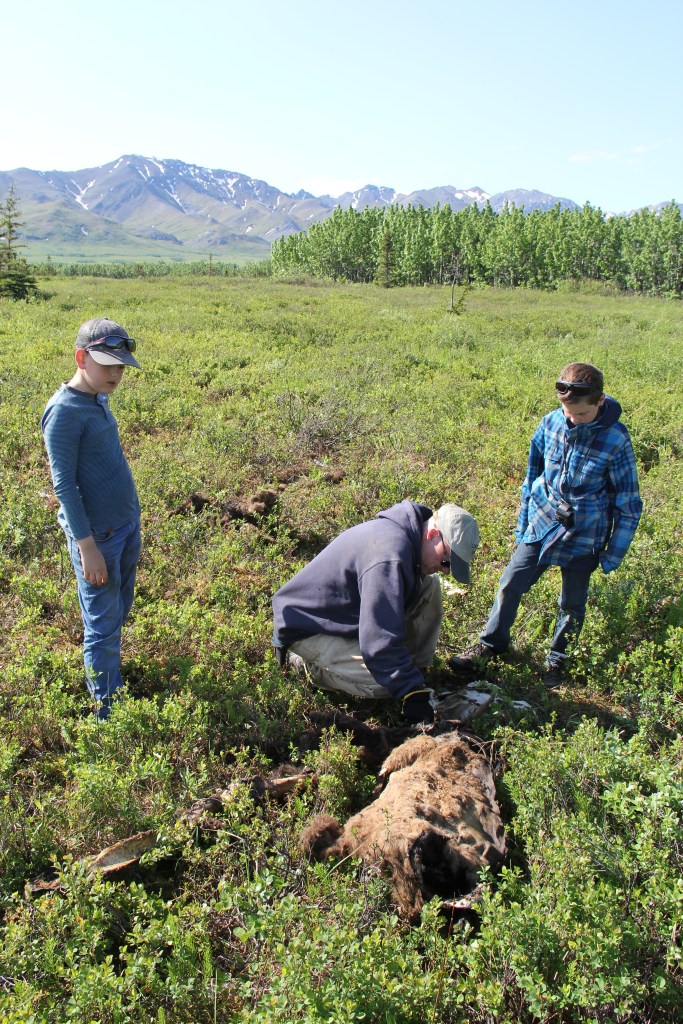
We spent time around the carcass looking for signs of how she died. Most of her bones were at the site: scapula’s, pelvis, backbone, leg bones and ribs along with the skull were all there together. This indicated she wasn’t killed by wolves, who typically drag off leg bones and other pieces from the kill site, to eat more peacefully away from the kill. There was one pile of what looked like black bear scat, filled with vegetation, but it was fairly old, and there were no teeth or chew marks on any of the bones, so it had not scavenged on the carcass. Based on the hard winter that was long, cold and snowy- much more so than usual- we concluded she had starved in the early spring.
When we returned to McGrath, Josh did some checking in his fish and game records and determined he had tagged her in 2017. We brought back the skull and jaw bone, and are hoping to figure out what age she was by doing an analysis of one of her teeth.
A few weeks later while flying, Benjamin and I spotted another dead bison about three miles from the other. We hiked out to it later and low and behold, it too was an adult female with a radio collar. Again, no sign of being killed by bears or wolves, and many of the bones were at the site. She had a very distinguishable skull and horn configuration pictured below. Here she was sedated while biologists fitted her with a radio collar in 2017. Her left horn (pictured on our right side of the photo) is the usual length, but her horn on the opposite side was damaged at some time in her earlier life, and stunted to a short length. This female also starved during the brutal winter of 2019-2020.
I sure hope our upcoming winter goes easier, but death on the tundra is all part of the natural process of life and death…..ashes to ashes and dust to dust.

 Alaska Wilderness Mom