It’s not every day you come across two bald eagles next to a road gripped to each other with deadlocked talons. This spring we received a call from a friend who exclaimed, “Hey, there’s two bald eagles next to the road trying to kill each other!”. As biologists who are trained in handling animals, we’ve gotten some interesting calls in the past related to injured animals, but this was a new one.
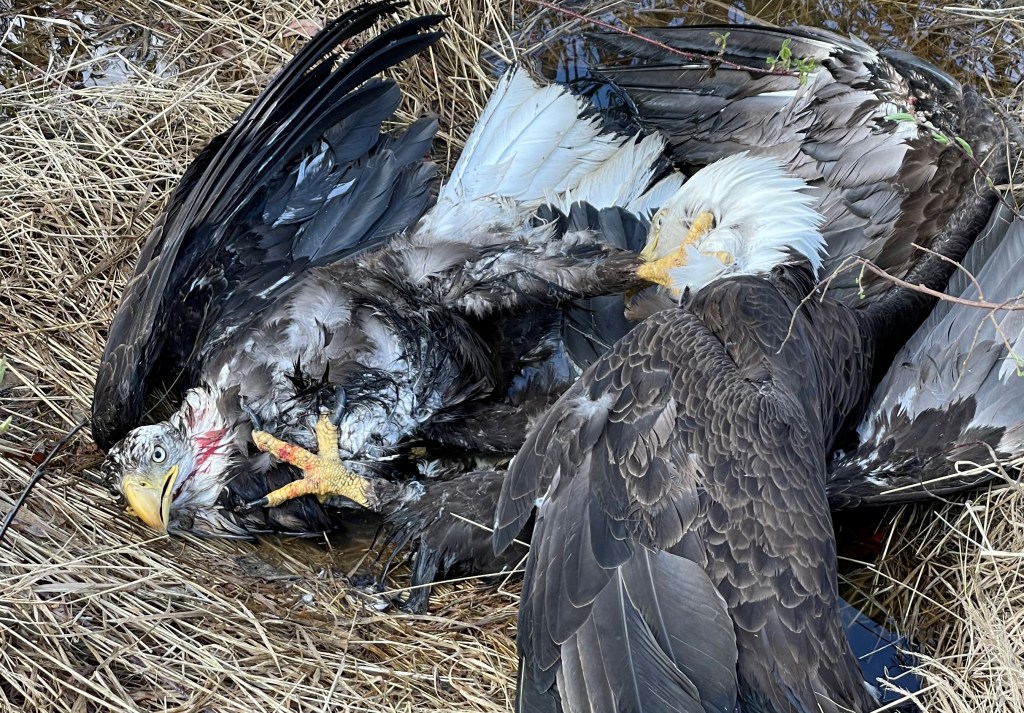
Josh and I suited up, grabbed some gloves and bags and headed down the road. We arrived at the scene a few minutes later. Two bald eagles were indeed next to the road and laying lifeless in a waterlogged grassy ditch. Specks of blood were splattered about one of the eagles and their talons were gripped onto each other in a deadlock.
At first glance, it appeared they were dead. They did not move as we approached. One eagle looked utterly mauled, feathers wet and spotted with blood. I grabbed my bags all the while wondering how much space we had in our wildlife freezer to store their carcasses.
Yet as we approached, their eyes moved. They were alive! But what were they doing on the ground, soaked from the swamp water, locked together in a stalemate? The more pressing question was, “Could we help them and get them apart?”
The rush of an ATV sounded behind us and we turned our heads to see a friend arrive on the scene to help. After assessing the options and getting some coverings for the eagle’s heads, we proceeded ever so cautiously to attempt to get the two birds apart.
Piercing bills that rip flesh and needle like claws called talons are the bald eagle’s life and survival. Would they release each other and use these on us I wondered as we moved in upon them?
Our friend took position on the mature eagle and as he supported the bird’s sides, I carefully folded its outstretched wings back up against its body. I gently grasped the bill and was impressed by the large size. My hands fit into a women’s large glove, yet the bill protruded several inches out of my grasp. For such an impressively large sized beak, it weighed next to nothing and was like a feather in my hand.
Meanwhile, Josh took hold of the other eagle and with secured, safe grips, we proceeded to pry toes and talons off to get the birds apart. This is more easily said then accomplished! The power and grip strength in those talons was unbelievable. To move one eagle toe up and off the body of the second eagle took all the strength of a strong grown person! I’ve seen how powerful eagle talons are from watching them grasp slimy, slippery, lively fish. I’ve seen them lock talons in the air and plummet towards earth’s surface. And I’ve seen them pluck fluffy, baby sea otters from the ocean’s surface while studying otters on Adak Island in the Aleutians. Now while trying to budge these yellow, chicken leggy like eagle feet I was seeing first-hand what it’s like to be on the other hand of things! It proved close to impossible to detach them from each other.

I ever so carefully touched this eagle’s feet. Serious weaponry. The curved black daggers protruding from the toes were razor sharp. These talons are nothing to mess around with and we proceeded with utmost caution.
With time, patience and persistence we succeeded in getting the two eagles apart. We surveyed their wounds, what we could see externally, and decided to carry them up to the road to release them. Josh held the immature, and our friend the other. They were released in intervals. They both took large hops and flapped their wings, trying to take off. But a soaked land bird cannot fly and despite their efforts, they remained grounded. The good news was their wings were not broken. Did they have other internal injuries that remained? Had they fallen from the sky and if so, how hard did they hit the ground? On lookers did not know.
The immature eagle hopped off in one direction into a neighboring yard while the mature eagle flapped and hopped well off the road and back into the woods. We watched them closely for a time and returned throughout the day to monitor their recovery. Several hours later the immature had flown up into a tree and had wings outstretched and was drying them. The mature eagle had hopped even further back into the woods and was on the ground with wings slightly outstretched.
In the early evening we took the kids and went for another check. Both eagles had flown off and were gone! The next day, our friend, who lives about ten miles from McGrath, saw a bald eagle circling his homestead- a sight he said he has rarely witnessed in over two decades of living there. Perhaps a thank you from the saved eagle some might say.


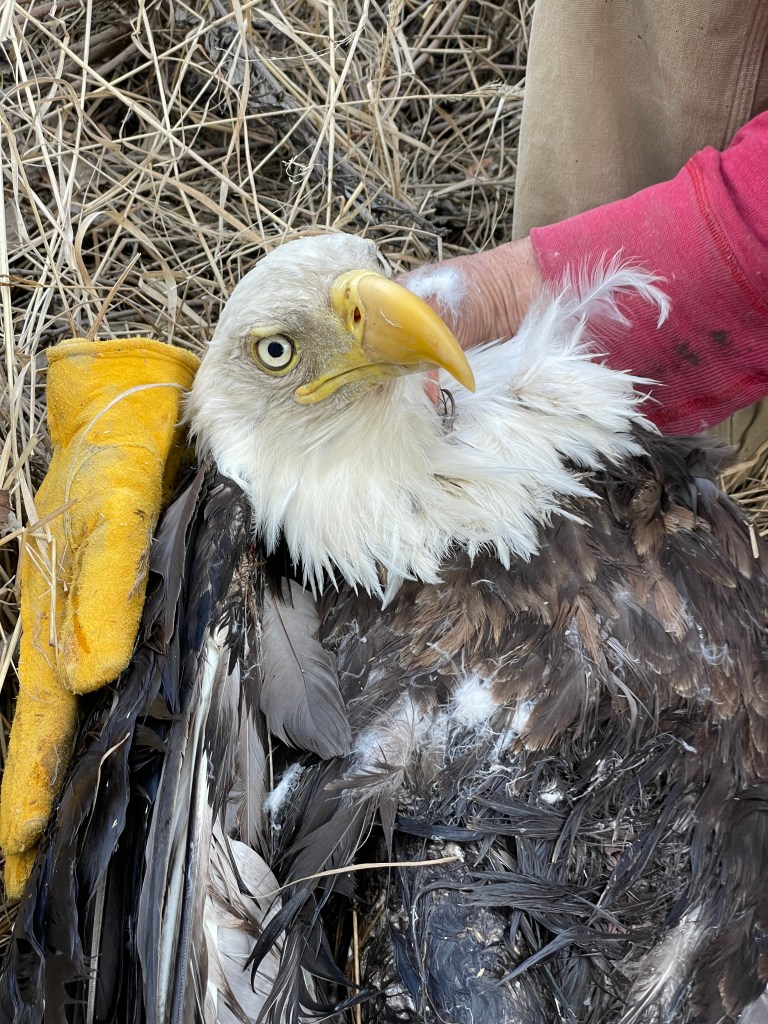
When bald eagles reach maturity around 4 to 5 years of age, they achieve their telltale plumage of an all-white head and black hew body. Younger eagles have a mottled brown feathering throughout with a brown bill and the white feathering on the head is absent. The eagle on the right is a fully mature bald eagle. It’s opponent on the left is most likely about 3 years old- the bill is orange and some white feathering on the tail is seen. Why they were fighting remains unknown but most likely it was territorial. Eagles typically exhibit talon locking if fighting over territory, food or during courtship behavior. This excitement all happened in May when eagles have nests established so perhaps the mature eagle was asserting its range and trying to drive off the younger.
What an exciting day in McGrath it was. It was an experience that gave me a new respect for the size, power and strength of our National bird.
To find out more on bald eagles check out the American Eagle Foundation’s web page.
 Alaska Wilderness Mom